
USDJPY

On the last post I noted that USDJPY was on a trading range, and the closest zone to watch was between 106.200 – 106.300. Prices reached that zone on the Asian session, and did so on wide high volume bars, breaking-out 106.200 to the downside, which also made the background turn to weak. The price was still sustained for a few hours after demand, but a few hours before London’s open, the activity spiked up again and more selling showed up again as a wide-range down bar, closing on its lows. These lower prices didn’t held up for long though, and after one more demand signal from VSA, the prices broke a down trendline and kept the uptrend until heavy supply hit the market and turned it sideways, onto the trading range we are seeing at the present. USDJPY is also getting to the break-out point of 107.600 support, which is important because that is the last point where many sellers got in. I would like to see a small rally after this downtrend, or the background turning weak, to consider taking short positions. Any position will have to be taken at most at tomorrow’s London session and in a low timeframe, as NFP is on Friday.

AUDJPY
This pair is near a support, at 79.527, and near a down trendline now at 80.100. Yesterday we have seen more demand above the formed support, though the rally after it failed spectacularly after there was no follow-up to the very high volume candle, with VSA showing a minor Supply signal 2 bars afterwards. The correction is showing low volumes, hinting at a temporary lack of supply, and the background is very strong. Reversals at sensitivity 7 have a good record on this pair and timeframe, even weeks back, and one near the support would be a possible long entry point. The safest would be to wait for the trendline break though, for confirmation. Meanwhile the prices are reaching the demand zone and it’s also important to be on the look-out for selling in the form of wide high volume down bars, like was seen on USDJPY yesterday on a similar occasion. Together with USDJPY, if the price/development confirms it, they could be two good pairs to trade against each other (one long and one short), since they are positively correlated by 50% due to the Yen.

Like I wrote in last Monday’s post, it was likely for the uptrend to continue due to the major shakeout, in the first blue rectangle. After the rally on the Asian session, yesterday by the end of NY session, we have seen one good VSA setup which will often mark as Top Reversal, near a zone of previous supply.
The reason why we commonly should consider this as sign of weakness are:
1. Volumes were decreased on two up bars when this candle tried to break 1.1050 level.
2. On the second try, which is marked in the 2nd blue rectangle, confirmed this as Top Reversal. Combination of two bars give us insight that supply has swamped the demand. First bar is marked up with very high volume and closing on the highs. And the next bar rapidly reverses down on a wide spread and closing on the lows.
The market went down quickly after, which gave no opportunity for a confirmation, in the form of an upthrust or no-demand bars. But as there was an up trendline nearby, its break would be another confirmation (Trendline breakout), of course, if you happened to be watching the markets in the mid of Tokyo’s session! EURUSD kept on downtrending and only more weakness after a significant rally would give another opportunity for a short. Below the support at 1.09394 I expect more demand to show up, as the trades who bought at the shake-out earlier might still be interesting in buying more at those prices.
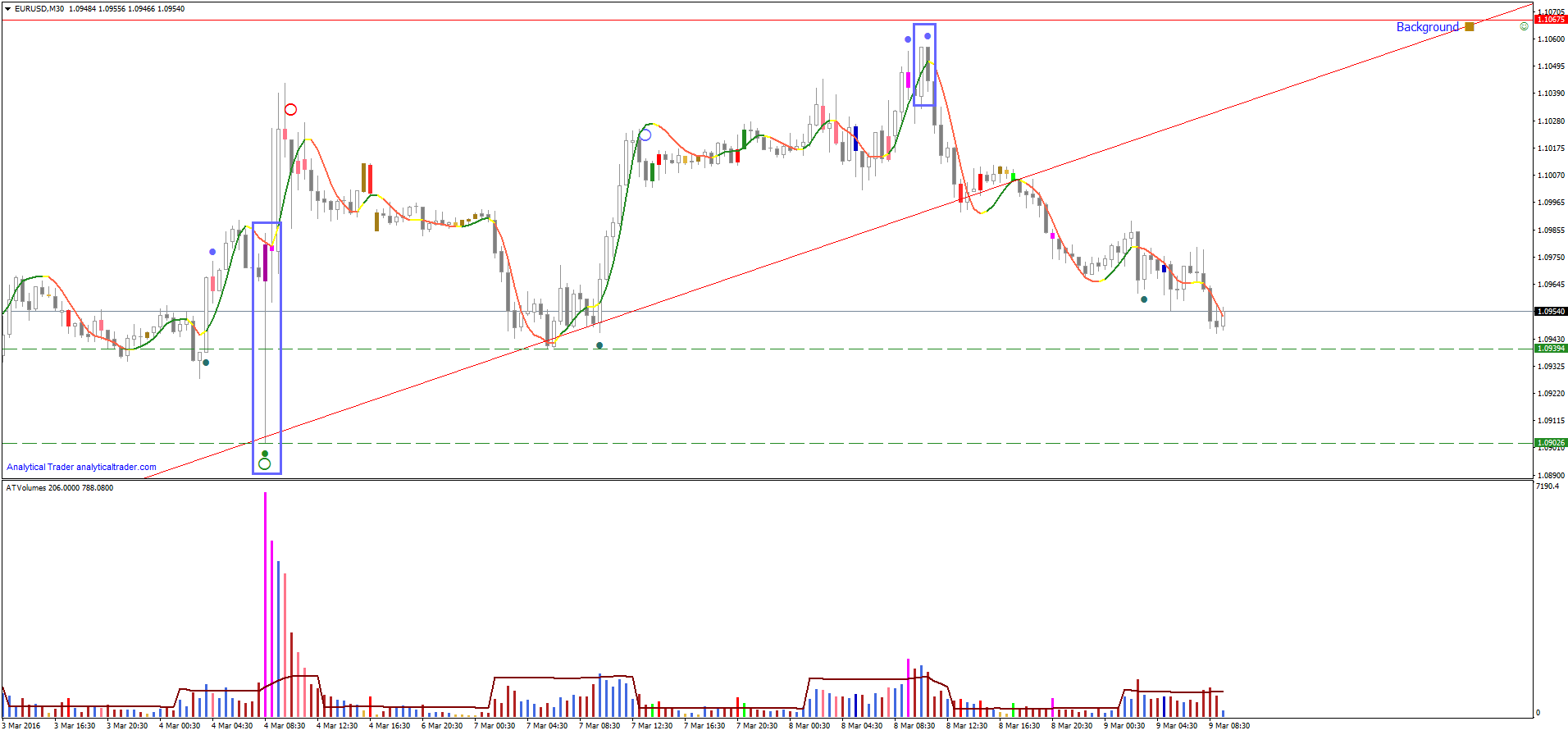
Distribution, Trend Changing in Eurusd
Starting from the end of January, we saw a steep down trend on the
USD/JPY. On the 11th February (zone 4) we can see large volumes at the bottom of the
market and as a result the price moved up and gained the level of 114.840, changing the structure of
the trend. Afterwards the market was stuck in a range (zone 5) and volumes have decreased. Such price
behavior at this zone can be seen as a no demand signal and is interpreted as lack of interest to
buy at the current price from large players, which prevented further price advances.

On the four-hour timeframe chart we have 5 zones, in which we can see the activity of the large players. Zone 1 is the beginning of bearish trend, where there was Major Supply from VSA on the current and above timeframe.
Zone 2 showed a thrust bar (the red bar), a bar that made a lower low than the previous. This pattern means that the large players tested the local level (117.50), and after confirming the lack of interest to raise the price (volumes were low afterwards and the price reversed from that level), bearish trend continued.
In the 3rd zone there is a continuation of the down trend, however there are also few demand signals below that zone. There is a demand on the daily chart and minor demand on 4hour chart. Taking into the account these signals individuallny we could assume, they they indicate the reversal of the market. However we should not forget that in the VSA method it is important to consider the wider picture of price movements in order to understand what is currently happening. It is important examine the background, which was weak a the time. In this context, these could have been locked-in traders getting their stop-losses hit, below the support.
The 4th zone turned out to be the point of the trend change. There are two large candles with a big volume, after which and the price starts to go upwards, breaking the previous structure of the trend. And the 5th zone, as it was mentioned in the beginning of the post, appears to be no demand signal, which led to a continuation of the down trend.
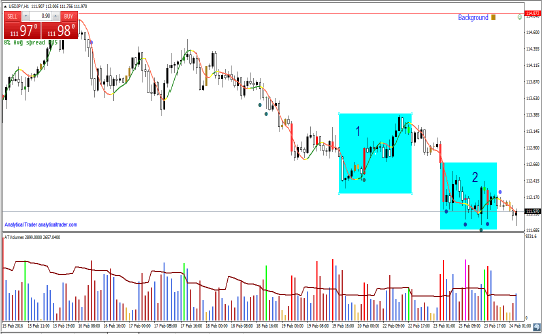
The hourly chart shows an attempt to make the move up (zone 1), which after churn bars, lead to the rapid fall of the price. In the zone 2 there are few bullish signals such as demand and minor demand. Obviously, they must be also interpreted in the context of general background which is weak, so it is too early to talk about the reversal. It is possible that the these signals were the result of hitting the stoplosses of the traders who held long position in the zone 1. At this point, the best solution would be to search for an entry point for a short position if more supply shows up, and at a better price.
Euro/Yen has been ranging since the beginning of January, when looked at from a 4-Hours perspective. Volume-wise though, it has been very active, and understanding this activity is essential to know what the major players are doing.
- First there were several demand signals just as 2016 was starting. This halted the down move. Afterwards there stopping volume when reaching 129.0 area (red bars).
- More recently, there was a major shake-out, painted as Major Demand by VSA – there was a lower low made, yet prices closed on the highs of the bar, and above the previous support. This was a move to hit stop-losses which provided plenty of liquidity for professional buying.
- Approaching the down trendline, there was a no-demand test (pink bar) – as prices penetrated the trendline, the volumes didn’t keep up, which means there wasn’t much demand. On the next bar, prices refused to close down though, on a relatively high volume. This could mean renewed interest in an up move, and the confirmation will be the trendline break on good volume (checking the hourly might be the best). If the bearish test succeeds, as in a failure to seeing a breakout of the trendline and/or test’s high in the next bars, I’d expect prices to drift downwards onto the support. The ultimate level to watch for is the resistance at 129.074.


In a big picture (daily timeframe) USDJPY is moving upwards (Mark-up phase). You see that it is possible to draw an up-trendline with several touches (5 times market touched this line).

In H1 timeframe we have 2 important levels: resistance and support.
Long-term resistance. This level has been showing itself during long period. Several times the market turned near this level. The longer resistance is working, the stronger it becomes. Now it will require effort to cross this line. Effort can be recognized as a high activity (high volume) or no interest (no demand/no supply) in the market (can be analyzed through volume spread analysis).
Last time we had an up-thrust near this resistance. Up-thrust is a wide spread up-bar, accompanied by high volume, to then close on the low. Up-thrusts are usually seen after a rise in the market, where the market has now become overbought and there is weakness in the background. Up-thrusts are frequently seen just before a down-move. Analytical Trader has detected two very weak signals (Major Supply) in this place and later the market moved down to the long term support.
Now the price has reached the long-term support and VSA indicator detected strong signal (background is strong). It is possible that the market will reverse in this place.

AUDUSD M30 Trade analysis:
- At the time of entry background was strong – it is wrong to be bearish in this place. Only weak background is a sign that imbalance between supply and demand is in favor of supply.
- Strong signal before trend changed. In addition, there is no weak signal. This is also wrong for a short trade.
- Entry was made when dynamic trend turned from green to red – ok.
- The trade was not closed after strong signal appeared in the chart. You should close the trade immediately in this place. Reversal signal is supporting exit in this level.

