

After opening an account with a broker, traders need to be aware of the different chart types out there. These are essential for traders in terms of decision-making as the information they supply is much valuable. In the following article, we will cover the most popular chart types used not only in Foreign Exchange but in most financial markets. We will also reference other ways in which technical analysis can be more effective. But first, how exactly are Charts illustrated in trading?
Chart
Charts are usually represented either linearly or logarithmically, being the X axis time and the Y axis price. Most commonly used Charts are time-based, but there are also popular Charts that do not rely on this factor, as we will see on ahead. As such, in this type of Charts, price movement is represented depending on what Time Frame you are analyzing. These can be set to be daily, weekly or even monthly or charted on Intraday Time Frames as small as 4 hours, 1 hours, 30 minutes, 5 minutes or even every 1 minute.
The main advantage of having several Time Frames is that you can conduct Multiple Time Frame Analysis. This, as we discussed in previous articles, is a great aid when trying to spot better trading Scenarios. Furthermore, being time-based, this enables traders to view prices live, base their actions on past data and time their orders in a simple and effective way.
Another indicator, often overlooked but commonly used with time-based Charts in technical analysis are Volumes. These give us the number of times a contract or share was traded in the market and are a measurement of market strength. This means that the relevance of the price action often depends on volume in that time.

Line Chart
The Line Chart, one of the simplest charts, only illustrates the closing price of the security in the specific Time Frame. The line is drawn, per example, by connecting the closing price of the GBP/USD at 11 p.m. to its next closing price at 12 p.m.

It is a clear and simple way of getting a general idea of the price movement’s direction in the market, which is preferred by some traders.
Nonetheless, it lacks information that is also important like the highest and lowest prices that the security reached in that Time Frame. This fact may be a deal breaker for traders whose strategies rely on these indicators, such as those who trade supports or resistances. Trading trends or retracements can also be applicable in a line chart. However, other charts simply provide a more in depth analysis than line charts which is in most cases is preferable for technical Analysis
Bar Chart
Bar Charts, also referred to sometimes a type of OHLC Charts, add on the previous chart by being able to show Opening, High, Low and Closing prices, as the acronym sujests. They are composed of a series of vertical lines that represent the price range during that Time Frame. In addition, each vertical bar has two horizontal bars: One on the left indicating at what price the security opened and another on the right indicating at what price it closed.

Contrary to the line charts this will enable the trader to paint a better picture of the market with ease. Patterns and different signs that these bars can give allow the trader for a much more thorough analysis.
Candlestick Chart
Similar to the bar chart, the Candlestick Chart gives traders the same information but are represented in a different way.
The wider part of the candlestick is shown between the opening and closing price. It is typically colored in black/red when the security closes on a lower price and white/green the other way around.
The thinner parts of the candlestick are commonly referred to as the upper/lower wicks or as shadows. These show us the highest and/or lowest prices during that timeframe, compared to the closing and opening price.
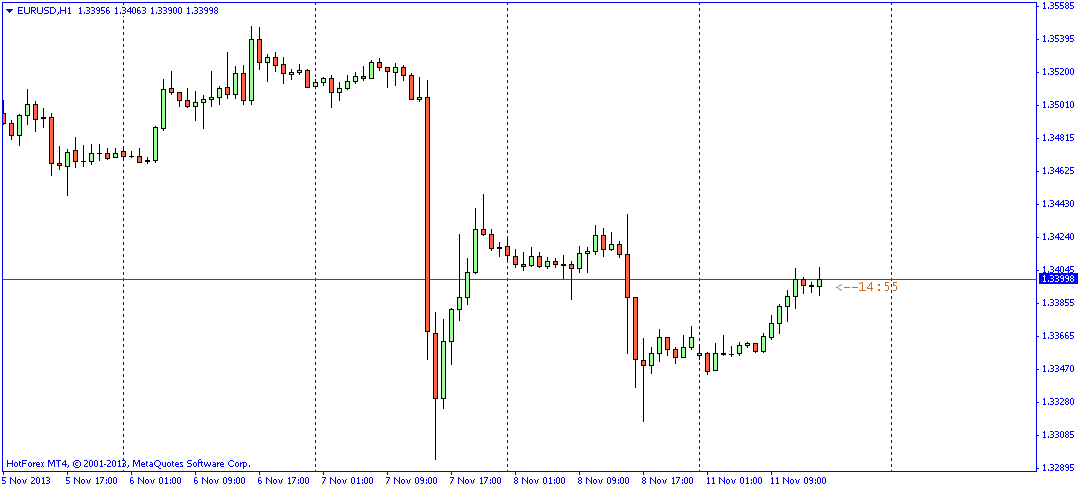
The main distinction between both charts has to do with the opening and closing prices. The bar chart focuses more on the relationship of the closing price from one Time Frame to another. On the other hand, with a quick look to a candlestick chart, market sentiment becomes much clearer. This due to the coloring of the real body of the candlestick which emphasizes the relationship between the closing and opening price within the same time frame. This illustration is one of the reasons why this type of chart is so popular.
Renko Chart
Unlike the other Charts, the Renko Chart focuses only on price movement, completely disregarding time and the usage of volumes.
This Chart is composed of white and black bricks. These are placed depending on weather the price rose or not compared with the previous brick. If it did by enough pips, established by the brick size, a new one is placed. White bricks are used when the price of the security goes up and black bricks when they go down.

It is important to point out the fact that a new brick is only placed under certain volatility criteria. Either resulting in a major advantage or disadvantage for traders. It can be placed in a matter of minutes or take more than a day depending on market conditions. On one hand, this may be advantageous. Especially for traders who want a simple way of identifying supports and resistances, the overall trend and filter noise. On the other hand, this can make market sentiment hard to determine. Consequently rendering the usage of other analysis tools useless.
To Sum Up
Each Chart has its own utility. However, their usage depends on the type of trader you are and strategies that you prefer to put in practice. So, having a general knowledge of the options you have when it comes to analyzing securitie’s behaviour is an advantage.
To go even further and put to practice some of the concepts discussed in this article you can download a demo of our VSA package. Improve your trading results with supply/demand Signals and other indicators that this Trading System provides.
Hope you enjoyed this article. Feel free to comment and share it with a friend!

Still on Forex terms and concepts, we found more terminology that we think is also really important. Especially for Traders wanting to open their first account and taking their first steps in Forex. As such, in this article we will go through 4 more concepts that traders starting out should know.
Lots
Generically, a lot is measurement for a group of goods, that are alike, that are transacted in the market. In Forex, lots are the standard measurement in trading when placing orders.
One lot represents an order of 100.000 units. This means that you would be buying/selling 100.000 units of the base currency while selling/buying 100.000 of the quoted currency.
Subdivisions of a lot are also common. Namely mini lots and micro lots, which ate composed of 10.000 and 1.000 units respectively.
Leverage
Being leveraged consists of contracting debt for whatever investment strategy a trader might have. It is mostly used as a way to aid and amplify a trader’s position on any type of financial asset. If a Trader opens an account with a leverage factor of 250:1, this means that for every euro he holds, he can control up to 250 euros. One can refer to this account as being highly leveraged.
It is important to point out that a common misperception is that having more leverage means that trading forex is riskier and thus should be completely disregarded. This is should not be the case. Traders should be aware of both sides of the coin.
The major benefit is that you can make much larger gains with a small investment. However the other way around also applies. Losses are amplified when the trade is leveraged.
So, taking this into consideration, if that added capital to your account is controlled, it will enable you to trade more currency pairs, a higher lot, and diversify your Portfolio.
Margin
Margin and leverage are two terms that refer to borrowing money. So, they might appear to be very similar. However, they should not be confused, as they are two different concepts.
If you have margin, this means you can borrow money from your broker at a fixed interest rate to invest. The act of borrowing the money with this purpose is to have a margin, whereas being leveraged is just having debt.
Simply put, if you are trading on a margin you have to be necessarily leveraged but the other way around might not be true. This because you can have leverage for a different purpose than to acquire financial assets.
Commissions
In Forex, these depend on the type of account you open with your broker. The most basic accounts that brokers usually offer don’t have any commissioning per negotiated lot, only a spread associated with trading.
Both “Pro” and “ECN” accounts, however, typically have commissions associated with each trade, with the added benefit of tighter spreads, being must more advantageous for Traders with more capital.
Moreover, it is also advised to take into account the spreads offered by brokers. More importantly, on the currency pairs that you normally trade as a few pips can make a difference in big lots.
To Sum Up
When first starting out, educating yourself is fundamental. Like we said in the previous article, there are many more concepts out there. As such constantly reviewing the ones you know and adding more to your vocabulary is a definite plus.
Hope you enjoyed this article. Feel free to comment and share it with a friend!

Like in any work environment, getting a hold of the terminology used on a daily basis is crucial. Trading forex is no exception. In this article we will go through some of the terms that we think are most commonly used in Forex. These are essential to better understanding how the market works.
Currency pair
All transactions being made in foreign exchange involve buying a currency while selling another one. Furthermore, a currency’s value can only be determined through comparison with another one. As such currencies are quoted in pairs. For example, one of the most traded currency pairs is the EUR/USD.
In this case, the base currency, the one on the left of the slash is the Euro. Conversely, the US Dollar is designated the quote currency. The base currency is the security you want to buy or sell while the quote currency sets the price at which you can exchange the base currency.
Still on the EUR/USD example, if the quote is 1.1862, this means that to buy 1 euro you would have to sell 1.1862 dollars. If the trader wanted to sell 1 euro he would receive 1.1862 dollars.
These currency pairs can be thought as being a single asset being traded. So, if someone buys the EUR/USD pair, this means that they are exchanging dollars for euros and when selling the other way around.
Major and Minor pairs
When talking about currency pairs, they can be usually referred to as Major or minor pairs. Major pairs are among the most transacted in Forex and the ones that offer more liquidity. For example the EUR/USD, USD/JPY and GBP/USD. All other currency pairs that aren’t as transacted are considered to be minor pairs.
It is also important to point out cross currency pairs. Although not so commonly traded, these are the currency pairs that don’t involve the USD, and thus usually have associated with them higher transaction costs.
Pips and Pippetes
A pip (percentage in point) is the most basic measurement of price movement in currency pairs in the Forex market. Usually, currency pairs are expressed to the fourth decimal case, being the pip the last one. For added precision, some traders even look at pippete, which are 1/10 f the pip, in other words, the fifth decimal case. So, for instance, if a currency pair changed from 1.1862 to 1.1863 this meant that it changed 1 pip. This measurement applies to most cases but there are some exceptions, such as the USD/JPY (109.55) which is presented in most cases to the second decimal case.
Being aware of pip variation is extremely important when calculating expected returns and positioning yourself in the market.
Bid-Ask Spread
The bid is the price that traders are willing to pay to acquire a security. On the other hand, the ask is the price that traders are willing to make to sell a security, being the bid the smallest of the two. These are, essentially, indicators of the supply and demand for a specific security. The difference between both gives us the bid ask-spread. The tighter the gap between both the more liquid is security being traded. In other words, it can be sold more easily and quickly converted to money. Trading currency pairs are thus considered to be the most liquid assets to trade.
You can think of this as an ongoing negotiation taking place in the market. On one side you have those who want to exchange the base currency for the quote currency. On the other side, you have those that want the exact opposite. The broker/market maker will offset this apparent imbalance in the market and charge you the spread every time you want to exchange. This is considered the main transaction cost each time you trade.
It is important to point out that the current price of a pair is usually neither the bid nor the ask. It is the price at which the currency was last exchanged.
Going Long/Short
As previously mentioned, when buying/selling currency pairs, this is usually done depending on a traders’ belief on the future value of the base currency compared to the quote currency.
A trader is said to be bullish when he has a positive expectation regarding the value of a pair. In foreign exchange, like in any other market, bull traders hope to profit from an upward movement in a pairs’ price. Simply put they hope to buy and hold a currency pair and eventually sell it at a higher price after appreciating in value. This is usually designated as “opening a long position“.
Investors’ and traders’ attitude towards the market is called sentiment. So, even though there are bull traders, pessimistic traders also exist.
Which brings us to bearish traders. A trader is said to be bearish when he expects a currency pair to devaluate. In this case, they will go short on a currency pair. This means that a trader will borrow a currency pair from a broker, sell it and then, when closing the short position, repurchase it to the broker at a lower price.
To Sum Up
There a lot of jargons used in Forex and it can be easy to be overwhelmed with all of these concepts. However, when you get down to what they really mean, it isn’t all that difficult.
Constantly learning about new ones, or just reviewing them, is essential to becoming a better trader. With this in mind, we advise you to read more on our other articles and improve your knowledge on the subject.
Hope you enjoyed this article. Be sure to comment and share it with a friend!

After the fall of the Bretton Woods System in 1971, the world’s major currencies soon followed a floating exchange rate regime. Simply put, this meant that a currency’s value would be determined based on its supply and demand compared with another currency. With the exchange rate being such an important factor weighing on a country’s economic growth, currencies are always highly demanded. From central banks and governments to retail traders and businesses, all constantly make and meet orders. This means that the Forex market has a lot of liquidity and is open 24 hours, providing a very flexible scenario for traders.
These factors are some of the main advantages of the Forex market over other financial markets such as the stock or bond markets. Nevertheless, this also has its drawbacks. Just because the market is always open on weekdays that does not mean that you get the same market conditions every time. Depending on the time and session you’re in, ranges, volumes and the pairs being predominantly traded vary.
In this article, we will discuss when one should trade by covering the main forex hours and sessions.
Major Forex Sessions
Firstly, what exactly are trading sessions? A trading session is a period of time during a business day in financial markets in which buyers and sellers set the current market price. In this case the pair’s exchange rate. In the Forex market, those considered to be the most important ones are the major financial centers in North America, Europe, and Asia. Namely Tokyo, London, and New York.
In the following table we can observe at what time they open and close according to the Greenwich Mean Time (GMT):

Note: It is important to point out that the Forex market opens on Sundays at 21.00 (GMT+0) and closes on Fridays at 21.00 (GMT+0) in the Winter time. Adjusting to your time zone and taking into consideration the daylight saving time, will tell you at what hours the market opens and closes for you. For example, if you live in Portugal (GMT+1), the market schedule will be from Sundays to Fridays at 22:00 pm.
Asian Session
Trading in the Asia-Pacific region accounts for approximately a quarter of all transactions made in Forex. When being referred to, the Asian Session is often associated with the Tokyo session as it is one of the largest trading centers in the world. This should come as no surprise as the Japanese yen is the third most traded currency in the world. However not only Japan trades in this session. Russia, Malaysia and South Korea are among others participating. Moreover, with Asia and the Pacific region’s rapid development over the years, financial centers such as Singapore, Hong Kong, and Sydney gained importance.
One characteristic of this session is that prices are usually less volatile and average hourly moves are smaller. This leads to supports and resistances being more likely to hold, allowing to trade ranges. Although less likely, news events can serve to trade breakouts as well.
Currency pairs that involve the Japanese Yen (JPY) , Australian dollar (AUD) or the New Zealand dollar (NZD) are more likely to show stronger movements. Being the first session of the trading day, it sets the tone for the following market sessions to come.
European Session
Before the Asian trading hours come to an end, the European session opens. A number of big trading centers operate during this time. However, London is undeniably the most important one. Mostly due to its location and the fact that it accounts for approximately 30% of all transactions being made in Forex. As a result, it is considered to be the Forex capital of the world and the epicenter of this session.
In the beginning, the previously stubborn supports/resistances are more likely to be broken due to volatility. This Tokyo/London overlap is the second most active period of the trading day, only outclassed in the afternoon. More specifically when London and New York are open at the same time.
During this session, the subjacent higher liquidity provides a better setup to trade trends. In between, as lunchtime approaches, there is a significant loss in activity as traders fuel up for the busiest overlap to come. At the end of the session, with so much activity, trends may reverse as traders seek to lock their earnings (excess supply/demand).
North American Session
The US Dollar is by far the most traded currency in the world. It is present in 80% of all trades being made in the market, either directly or as a vehicle. Like all currencies, fundamental economic variables support its value. In this case, those variables come from the world’s largest economy, the United States, hence its value.
As previously mentioned, the most active hours occur when major sessions overlap. Being the London/New York overlap the most active one, this allows for transaction costs to be at their lowest values. The bid-ask spread is thus minimized and placing orders becomes much cheaper. With so much liquidity nearly any pair can be traded, but major pairs like EUR/USD, USD/CHF and GBP/USD offer the smallest spreads.
After the overlap with the European session, activity usually dies down. At the end of the New York session, most traders start closing their positions. Those that trade the North American/Asian overlap still find some liquidy. However not as pronounced, and falling once more into the range trading associated with the Tokyo session. The market activity naturally reaches its lowest point on Friday afternoon.
To Sum up
Some might argue that the Asian session is the best as low volatility enables you to manage your trades more functionally . Others might say that most liquid hours will provide more opportunities for good trades. So overlapping sessions are the best answer. But it all comes down to the same thing. It depends on what works better for you.
When deciding when to trade you should take several factors into consideration:
- Volatility – Evaluate if greater pip ranges suit your trading and risk profile or not;
- Your schedule – There is always a new opportunity for a good trade. There is no need to overdo it. Being tired or not having the right mindset won’t help your results at all;
- Other time frames – Don’t stick to just one time frame. Conducting multi-timeframe analysis will enable you to better identify trends and signals;
- Economics Drivers – Central banks’ reaction to economic growth, commodity trading, etc. Being aware of them can greatly aid your market analysis and ultimately provide you with better trades;
Hope you found this article useful. Be sure to comment and share this article with a friend!

Trading Forex might seem like a fast and easy way to make money due to its high liquidity, leverage and many trading opportunities. However, many common mistakes are made, and getting started isn’t as easy as one might think. In this article, we will go through 4 challenges newbie traders face when taking their first steps in the Forex Market.
1 – Too much Information
Better understanding the market before risking your own money is always a good idea. Often newbie traders have high expectations regarding trading that do not correspond to reality. Consequently, such an approach can come at the cost of your whole account. So, educating yourself is key to avoid falling into these types of mistakes. You should get acquainted with different strategies, indicators, on what time-frame to trade, etc.
However, too much information can easily be overwhelming. Distinguishing good advice from all the noise the internet has to offer is definitely a challenge. Especially for any traders starting out.
Thus, finding the absolute way of getting money without fail will always be impossible and you will never start trading, which leads us to the next challenge newbie traders usually face…
2 – Sticking to a Trading Plan
There always seems to be a new strategy out there that is better and more efficient than the one you are currently approaching. This idea goes in line with what we previously discussed, as too much information can actually cut down your profits.
The bottom line is that you should find the strategy that best fits you and run with it. What might seem like a winning strategy for one person may not apply for you. Trading Forex is a learning process and only through practice, learning with the mistakes you make and sticking to one strategy for a while will you be able to perfect your craft.
3 – Finding the Right Mindset
Being able to trade with a clear mindset has and always will be a challenge. From the most experienced traders to the newcomers in the Forex market, all of them at some point fail to trade with their heads in the game.
Being undercapitalized in the beginning, for instance, puts a lot of emotional pressure for time and money on newbie traders. Often, this leads to impatience when looking for the right setup to open a position, usually resulting in reckless trading.
Another example is not knowing when to close a position and accepting a loss, and in trading you can’t really afford to do that. Always setting a stop-loss and moving on to another trade when things don’t turn out as expected is the way to go.
If you would like to know more on the subject check our article on building a winning traider mindset.
4 – Trade for the Long-Run
Without proper planning, several losses that traders might have will make them lose interest and curse Forex. That’s why newbie traders need to have a long-term perspective. Potential blows that they experience won’t then be as hurtful.
Recurring to money management techniques in Forex trading is thus detrimental for this to occur.
Instead of risking half of your account in one trade, establishing a realistic risk/return ratio each time you trade, according to your risk profile, will enable you to trade consistently. Furthermore, it will allow newbie traders to stay motivated and better cope with their losses.
To Sum up
Newbie traders should focus on getting acquainted with trading systems and trading platforms. After doing so, practice with historical data, challenge yourself, and eventually, you can start to trade for real.
Having friends or colleagues who are also interested in Forex and developing a community also makes a huge difference. Mainly because you can find support in them and share experiences.
Lastly, developing and maintaining a strong mindset, regardless of any market conditions or any other factors, will be fundamental.
Feel free to leave a comment below, ask any question or provide feedback on this article. If you enjoyed it, don’t forget to share it with a friend!

To be successful in trading, you need more than a winning strategy. You need to have the correct trading mindset to succeed over the long run. A trader with a winning strategy but who starts being overconfident about it may end up losing control and making mistakes. To be a winner, it’s important to have several edges against all the other traders. One of this edges is mental – you should think like a winner to become one. In this article, we present 9 characteristics of a successful trading mindset, which will give you some powerful insights to complement you as a winning trader.
1 – Flexibility
First of all, you need to be flexible and open-minded. Especially in Forex, given that the market is open 24h a day, you need to be flexible enough to trade during the London session, the New York session and the Tokyo session. A good opportunity may appear at any time, and you need to be ready to be there and catch it. Besides, open-mindedness is really important when analyzing a currency. Markets change fast, and what was true last week may not necessarily be correct this week. You should always keep your mind open to sudden changes that may occur.
2 – Find what works FOR YOU
There are some traders who prefer to risk more, others prefer to trade only during a certain session, others like to look only at fundamental analysis and some only trade on technical analysis. This means that each one of us should develop a strategy that is good only for himself. What has proved to be a winning strategy for your partner may not necessarily work that well for you. He may look at the market in a different way than you do, and the strategy will reflect that. In this sense, you should discover what is your trade profile and start working on a personal trading strategy or use a proven trading strategy that fits you.
3 – Don’t be overconfident when you win
We all know how it’s easy to become overconfident after a good winning streak. However, it’s crucial to maintain the same posture towards trading as always. If you become too confident and start being more relaxed about your trades, hoping that you’ll continue to win, you may end up losing what you already won because of your sloppiness. Basic mistakes can occur due to a lack of attention. Instead, you should “convert” your confidence into focus to keep having good results.
4 – Don’t lose your confidence after some bad trades
As important as not being overconfident when you win is to not lose your confidence after some bad trades. It’s usual to have some bad moments and enter on a losing streak. This doesn’t necessarily mean your strategy is failing or you’ve lost the plot. Even the best strategies happen to fail under certain market conditions, and losing is important to improve your trading. If you’re having troubles in being confident, you may want to check our article on 3 Ways to Boost the Confidence in Your Trading.
“Losing a position is aggravating, whereas losing your nerve is devastating.”
– Ed Seykota
5 – Don’t trade to get your money back
As we all know, it’s difficult to remain focused after a bad trade. Besides losing confidence, it’s usual to see traders getting angry and trying to recover what they’ve lost. First of all, don’t let your emotions interfere with your trading, that will only guide you to a poor performance. Second, don’t trade just to recover your losses, as you’ll probably end up losing even more. Instead, you should remain calm and recover what you’ve lost over a certain period of time and get back on track. Haste will not lead you to good decisions. Besides, getting into a confrontation with the market won’t recover your losses. Don’t be mad at the market, try instead to think about what went wrong and improve it.
6 – Don’t trade just for the money
This may seem a little bit strange since the majority of traders do it to earn some money. However, some of the greatest traders of all time, like it is the case of Ed Seykota, reach a state in which they “forget” about the money involved and are much more focused on being good traders than in the money they can make. Always thinking about money may prevent you from focusing solely on your analysis and making the right trades. Moreover, if you’re a good trader, the returns will eventually come.
7 – Be patient
One of the most important characteristics of a successful trader is being patient and wait for the right chance. The market is full of opportunities, you only have to be aware and get the right ones. Sometimes prices may be flat for a long period of time, without any major change worth trading. During this time you should not “force” any trade, simply wait for a better time. Some strategies work better under specific market conditions. By applying them in a different way, you may risk its failure. If you wait for the certain opportunity, you’ll have a higher chance of success.

8 – Trade with money you can afford to lose
In our article about money management, we give some advice about how much money you should put in each trade and how you can ensure a positive expected return. It’s crucial that you don’t risk too much in each trade given that, if things go against what you planned, you may end up losing more than you can afford. Take small losses and let your profits run. The more you lose in each trade, the higher your winning rate has to be in order to be profitable over the long run.
9 – Be realistic
The final characteristic of a successful trader is the ability to be realistic regarding your expectation. If you don’t already know how much money you should expect to make in Forex, our article may give you some help on that. No trader starting with 1000€ can expect to win like 10,000€ per month. Your account will grow slowly at the beginning and then the compounding effect will ensure you win more as time goes by. Keep a realistic expectation about what you can win and define your goals according to that view.
The Bottom Line
To be a successful trader, you have to get as many edges as you can, and the mental edge is one of the most important. The above-mentioned characteristics are some of the ones you should try to implement to improve your trading mindset. This will complement your strategy and turn you into a mentally strong trader, able to go through bad times and prosper on good ones.

